

Reviewed by the Marketing Team Last updated
Minnesota has some of the nation’s most comprehensive impaired-driving laws, and the consequences of an arrest often begin long before a case reaches the courtroom. In many situations, drivers face both criminal charges and administrative penalties at the same time. A single incident can affect driving privileges, insurance costs, employment opportunities, professional licenses, and even future legal matters.
This Martine Law guide explains the complete DWI process from beginning to end. You will learn how the state defines driving while impaired, what penalties may apply, how license revocation proceedings work, what defenses are sometimes available, and what you should expect as your case moves forward.
What Is a Driving While Impaired?
Many people also wonder whether there is a difference between a DUI and a DWI. Although the terms are often used interchangeably throughout the United States, Minnesota statutes use the term DWI.
In Minnesota, a person may be charged with driving while impaired (DWI) when alcohol, drugs, or a combination of substances affects the person’s ability to operate a motor vehicle safely. The offense is governed primarily by Minnesota Statutes Chapter 169A. Prosecutors generally do not have to prove that a driver was visibly intoxicated. A charge may arise from a chemical test result, evidence of impairment observed by law enforcement, or both. The state recognizes several important blood alcohol concentration (BAC) thresholds:
- 0.08% BAC for most drivers age 21 and older
- 0.16% BAC or higher, which is considered an aggravating factor and may lead to enhanced penalties
- 0.04% BAC for individuals operating commercial vehicles
- Underage drivers may face consequences under Minnesota’s laws prohibiting alcohol consumption by individuals younger than 21, even when the amount of alcohol involved appears relatively small.
Alcohol is not the only substance that can lead to an arrest. The law also prohibits driving while impaired by controlled substances, cannabis products, prescription medications, and certain over-the-counter medications if they affect a person’s ability to drive safely.
A common misconception is that a prescription automatically protects a driver from prosecution. In reality, legally prescribed medication can still support a charge if it impairs the person’s physical or mental abilities. Likewise, the state’s zero-tolerance approach to certain controlled substances means that even a small amount of an illegal substance in a driver’s system may lead to serious legal consequences.
Understanding how the state defines a DWI is the first step toward understanding what happens after an arrest, from roadside investigations to license revocation proceedings and criminal court appearances.
The Four Levels of DWI Charges in Minnesota
Not every charge is treated the same way. The state uses a four-tier system that increases penalties as aggravating factors accumulate. Prior offenses, a high alcohol concentration, the presence of a child in the vehicle, and test refusal allegations can all affect the severity of a case.
Understanding where a charge falls within this framework is important because the degree of the offense can influence jail exposure, fines, license revocation periods, ignition interlock eligibility, and the long-term consequences of a conviction.
| DWI Degrees | When Charged | Classification | Maximum Penalty |
|---|---|---|---|
| Fourth-Degree | First offense with no aggravating factors | Misdemeanor | Up to 90 days in jail and a fine of up to $1,000 |
| Third-Degree | One aggravating factor is present | Gross misdemeanor | Up to 364 days in jail and a fine of up to $3,000 |
| Second-Degree | Two or more aggravating factors are present | Gross misdemeanor | Up to 364 days in jail and a fine of up to $3,000; vehicle forfeiture may also apply in qualifying cases |
| First-Degree | Three or more qualifying impaired-driving incidents within ten years, or a prior felony DWI conviction | Felony | Up to 7 years in prison and a fine of up to $14,000 |
These penalties are established under the statute Chapters 169A and 609, and the actual outcome depends on the specific facts of the case.
What Counts as an Aggravating Factor?
The law identifies several circumstances that can elevate a charge to a higher degree. Common aggravating factors include the following:
- A blood alcohol concentration (BAC) of 0.16 percent or higher
- A child younger than 16 years old being present in the vehicle when the driver is more than 36 months older than the child.
- A prior DWI conviction, license revocation, impaired-driving-related loss of driving privileges, or other qualifying impaired-driving incident within the previous ten years
- Refusal to submit to a chemical test when required under Minnesota’s implied consent law
Aggravating factors can dramatically increase the consequences of an arrest. For example, a driver with no criminal history could face substantially different penalties if testing indicates a BAC of 0.16 percent or above. Likewise, an incident that might otherwise be charged as a misdemeanor can become a gross misdemeanor or felony when prior offenses exist.
Because prosecutors and courts closely examine a driver’s record and the circumstances of the arrest, accurately identifying the applicable degree of the charge is one of the first steps in evaluating a case.
What Happens at Arrest – The First 24 Hours
For many people, the most frightening part of a case is the first day. Events move quickly, important decisions must be made immediately, and mistakes can have consequences that last for years. Understanding what normally happens during the first 24 hours can help you better protect your rights and prepare for the next stage of the process.
The Traffic Stop and Field Sobriety Tests
A case usually begins with a traffic stop. An officer may claim to have observed speeding, weaving, an equipment violation, erratic driving, or another circumstance that justifies the stop. Once contact is made, the officer may look for signs of impairment, including:
- The odor of alcohol
- Bloodshot or watery eyes
- Slurred speech
- Confusion or difficulty answering questions
- Open containers in the vehicle
The officer may then ask the driver to perform field sobriety tests or submit to a preliminary breath test (PBT). These tests often become important pieces of evidence in later proceedings.
The Implied Consent Advisory
If the officer believes there is probable cause for an arrest, the implied consent law comes into play. At this stage, the officer must read an advisory informing the driver that:
- The law requires drivers to submit to chemical testing under certain circumstances.
- Refusal to take the test is a crime.
- The driver has the right to consult a DWI attorney, provided doing so does not unreasonably delay testing.
The exact wording of the advisory and the way it is administered can become significant issues later in the case.
The Breath, Blood, or Urine Test Decision
Depending on the circumstances, the officer may request a breath, blood, or urine sample. The type of test selected often depends on factors such as:
- Whether alcohol or drugs are suspected
- The availability of testing equipment
- The driver’s physical condition
- The investigating agency’s procedures
Although drivers have legal rights, they are also operating under strict timelines. Decisions made during this stage can affect both the criminal case and the status of the driver’s license.
Consequences of Refusing Chemical Testing
Many drivers believe that refusing testing automatically improves their position. In reality, refusal frequently creates additional legal problems. Test refusal can itself result in criminal penalties and may be treated as an aggravating factor when charges are filed. Refusal can also lead to longer periods of license revocation and additional administrative consequences.
Booking, Custody, and Release Conditions
After the arrest, officers generally transport the driver to a local jail or detention facility for booking. During this process, law enforcement officers may:
- Take fingerprints and photographs.
- Record identifying information.
- Inventory personal property.
- Issue citations or formal charges.
Some individuals are released within a few hours, while others remain in custody until bail is posted or a court appearance takes place. Conditions of release may include restrictions on alcohol consumption, travel limitations, or participation in alcohol monitoring programs.
Vehicle Impoundment and Whiskey Plates
Certain circumstances can trigger the impoundment of a vehicle or the requirement to obtain special registration plates, commonly called whiskey plates. These consequences frequently arise when aggravating factors are present, particularly in cases involving high alcohol concentrations, repeat offenses, or test refusals.
The next phase of the process focuses on what happens after release, including the separation between the criminal case and the administrative proceedings involving driving privileges.
Important: In many cases, drivers have only 30 days from receiving notice of revocation to petition the court for judicial review of the revocation decision. Missing this deadline can severely limit the options available later in the case.
Administrative License Revocation
One of the most confusing aspects of a case is that two separate proceedings begin almost immediately. The state simultaneously starts an administrative action against the driver’s license. In many cases, this administrative process begins long before a judge decides whether the person is guilty or innocent.
Immediate License Revocation
Following a failed chemical test or an allegation of test refusal, the Minnesota Department of Public Safety may issue a Notice and Order of Revocation. The length of the revocation period depends on factors such as prior offenses, alcohol concentration, and whether the driver refused testing. This means that a person can lose driving privileges even while the criminal case is still in its earliest stages.
The Thirty-Day Deadline
The law gives drivers a limited amount of time to challenge the revocation through a petition for judicial review. In most cases, the petition must be filed within 30 days after the individual receives notice of the revocation. Missing this deadline can have serious consequences because the court may lose the authority to review the administrative action.
What Happens If You Do Not File?
Failing to file a timely petition does not automatically determine the outcome of the criminal case. Depending on the circumstances, drivers may face:
- Extended periods of license suspension or revocation
- Additional fees and reinstatement requirements
- Mandatory participation in the ignition interlock program
- Delays in restoring full driving privileges
Because the administrative and criminal proceedings operate independently, a favorable outcome in one matter does not necessarily guarantee a favorable outcome in the other.
Administrative Consequences Vs. Criminal Penalties
The administrative case focuses primarily on driving privileges, while the criminal case addresses issues such as guilt, sentencing, probation, fines, and incarceration. Administrative proceedings typically involve questions such as:
- Whether the officer had a legal basis for the stop
- Whether the arrest was lawful
- Whether testing procedures were properly followed
- Whether the driver’s rights were respected
Are Limited Driving Privileges Available?
Some drivers may qualify for restricted driving privileges or participation in the ignition interlock program. Depending on the circumstances, these options may allow an individual to drive for employment, educational purposes, medical appointments, or other approved activities. Because eligibility requirements vary considerably, it is important to evaluate these options as early as possible rather than waiting for the criminal case to conclude.
The Criminal Case Process for Your DWI
The arrest is only the beginning of a process that can continue for months and, in some felony cases, more than a year. Although every case is different, most proceedings follow a similar pattern. The timeline below provides a general overview of what defendants can expect after an arrest.
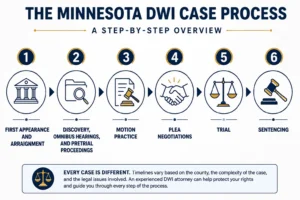
1. First Appearance and Arraignment
The first court appearance often takes place within a day or two of an arrest, although the exact timing depends on whether the individual remains in custody. During this hearing, the court formally advises the defendant of the charges, explains important legal rights, addresses bail or other conditions of release, and schedules future proceedings. The judge may impose conditions such as abstinence from alcohol, random testing, electronic monitoring, travel restrictions, or ignition interlock requirements.
2. Discovery, Omnibus Hearings, and Pretrial Proceedings
Both sides begin exchanging evidence through the discovery process. Prosecutors may provide police reports, body camera recordings, squad car video, chemical test records, laboratory results, witness statements, and other evidence that will be used in court. During omnibus and other pretrial hearings, the court addresses procedural and constitutional issues that could affect the outcome of the case. Questions frequently arise regarding the legality of the traffic stop, the existence of probable cause, the administration of field sobriety tests, the implied consent advisory, and the handling of chemical evidence.
3. Motion Practice
Motions allow Minnesota lawyers to ask the court to resolve specific legal issues before trial. Depending on the circumstances, the defense may seek to suppress evidence, exclude witness testimony, challenge the reliability of chemical testing procedures, or request dismissal of some or all charges. These proceedings can become highly technical because they often involve constitutional questions concerning unlawful searches, improper seizures, due process rights, and the admissibility of scientific evidence.
4. Plea Negotiations
Negotiations between the prosecution and the defense may begin shortly after the arrest and continue throughout the case. A negotiated resolution may involve amended charges, reduced penalties, modified probation conditions, participation in treatment programs, or agreements concerning license-related issues. Factors that frequently influence negotiations include prior convictions, alcohol concentration levels, test refusal allegations, aggravating factors, the strength of the evidence, and the defendant’s personal circumstances. Not every case is resolved through negotiation, but many cases conclude before reaching trial.
5. Trial
If the parties cannot reach an agreement, the case may proceed to trial. Defendants generally have the right to challenge the state’s evidence, question witnesses, present their own evidence, and require the prosecution to prove every element of the charge beyond a reasonable doubt. Issues commonly addressed at trial include the basis for the traffic stop, the accuracy of testing procedures, the reliability of field sobriety tests, the credibility of witnesses, and the interpretation of scientific evidence. Felony cases often require considerably more preparation and may take substantially longer to reach this stage.
6. Sentencing
If a defendant pleads guilty or is convicted, the court proceeds to sentencing. Judges consider numerous factors, including criminal history, aggravating circumstances, participation in treatment programs, the level of cooperation shown during the proceedings, and recommendations from both parties. Sentences may include fines, incarceration, probation, community service, alcohol treatment programs, electronic monitoring, ignition interlock participation, and other conditions required by law.
How Long Does the Entire Process Take?
A straightforward first-offense case may be resolved in approximately three to twelve months, depending on the county, the complexity of the evidence, and whether motions are filed. Felony cases, cases involving serious accidents, and matters involving multiple legal challenges frequently take much longer. Understanding the sequence of events can help drivers make informed decisions and avoid overlooking critical deadlines while the case moves through the court system.
Although general timelines can be helpful, no two DWI cases are identical. For a clearer understanding of what to expect in your case, contact our team at +1 (612) 294-0650 for a confidential consultation. Phones and chat are answered 24/7, with AI covering when no staff is free.
Potential Penalties for a DWI in Minnesota
Depending on the circumstances, a sentence may include incarceration, fines, probation, treatment requirements, community service, vehicle sanctions, and restrictions on future driving privileges. The severity of the penalties generally depends on the degree of the offense, the driver’s criminal history, the presence of aggravating factors, and whether anyone was injured.
Jail Time and Mandatory Minimum Sentences
The law establishes maximum penalties for each degree, but mandatory minimum penalties may also apply in certain circumstances.
| DWI Charges | Maximum Jail Sentence | Mandatory Minimum Requirements* |
|---|---|---|
| Fourth-degree | 90 days | No mandatory minimum incarceration in many first-offense cases |
| Third-degree | 1 year | Mandatory minimum penalties may apply when aggravating factors are present |
| Second-degree | 1 year | Mandatory minimum penalties generally apply and may include incarceration or electronic home monitoring |
| First-degree | 7 years | Longer mandatory minimum periods may apply, particularly in repeat-offense cases |
*The precise sentence imposed depends on the driver’s record, alcohol concentration level, test refusal allegations, and other circumstances.
Judges retain a degree of discretion, but sentencing guidelines and statutory requirements often limit the available options.
Fines, Fees, and Other Financial Costs
The financial impact of a conviction frequently extends well beyond the fine listed in the statute. Potential costs may include:
- Court fines
- Surcharges and administrative fees
- Towing and vehicle impoundment expenses
- Ignition interlock costs
- Increased insurance premiums
- Alcohol treatment expenses
- License reinstatement fees
Maximum fines range from $1,000 for fourth-degree offenses to $14,000 for first-degree felony convictions.
Probation Requirements
Many defendants are placed on probation, even when jail time is reduced or suspended. The conditions imposed vary from case to case but commonly include:
- Remaining law-abiding
- Abstaining from alcohol and controlled substances
- Submitting to random testing
- Meeting regularly with a probation officer
- Maintaining employment
- Completing educational or treatment programs
Violating probation can lead to additional sanctions and, in some cases, the execution of a previously suspended jail sentence.
Chemical Dependency Assessments
The courts frequently require defendants to undergo a chemical dependency evaluation. This assessment examines the individual’s history of alcohol or drug use, identifies potential treatment needs, and provides recommendations to the court. Judges often rely heavily on these recommendations when determining probation conditions and sentencing requirements.
Victim Impact Panels
Some courts require attendance at a Mothers Against Drunk Driving (MADD) Victim Impact Panel or a similar program. These presentations allow participants to hear directly from individuals and families affected by impaired driving incidents. Completion of the program may be incorporated into probation conditions or negotiated resolutions.
Ignition Interlock Requirements
An ignition interlock device is a breath-testing system installed in a vehicle that prevents the engine from starting when alcohol is detected. Participation in the Ignition Interlock Device Program (IIDP) may be required after:
- A test refusal allegation
- A high alcohol concentration of 0.16 percent or greater
- Multiple DWI convictions
- A lengthy license revocation period
- Certain felony DWI convictions
The duration of participation depends on the driver’s record and the specific circumstances of the case.
Community Service and Alternative Sentencing
In some situations, judges may permit community service, electronic home monitoring, work release, treatment programs, or other alternatives in place of some incarceration time. These alternatives are not available in every case. Still, they can play an important role in addressing rehabilitation while allowing individuals to continue working, supporting their families, and complying with court-ordered obligations.
Collateral Consequences of a DWI
The formal penalties imposed by the court are only part of the picture. Even after a sentence has been completed, a conviction can continue to affect many aspects of a person’s life, including employment opportunities, finances, professional advancement, and family relationships. These secondary effects are often called collateral consequences because they extend beyond the criminal penalties ordered by the court.
Employment Opportunities
Many employers conduct criminal background checks before hiring new employees. A conviction may create difficulties for applicants seeking positions that involve driving, operating heavy equipment, working with vulnerable populations, obtaining security clearances, or handling sensitive information. Commercial drivers, rideshare operators, delivery drivers, and individuals whose jobs require frequent travel may face particularly significant challenges.
Professional Licensing
Certain professional licensing boards have the authority to investigate alcohol-related offenses when determining whether a person meets professional standards. Depending on the occupation, a conviction could affect applications for licenses involving health care, law, education, finance, real estate, insurance, aviation, and commercial transportation. In some situations, reporting requirements may apply even if no disciplinary action is ultimately taken.
Automobile Insurance Costs
Insurance premiums frequently increase after an arrest or conviction. Drivers may also encounter additional fees, policy restrictions, higher deductibles, or difficulties obtaining coverage altogether. These increased costs often continue for years after the case has ended.
Child Custody and Family Law Matters
The family courts focus heavily on the best interests of the child. Although a single DWI conviction does not automatically result in the loss of custody or parenting time, the court may consider evidence of alcohol misuse, repeated offenses, or behavior that places children at risk. Cases involving a child who was present in the vehicle at the time of the arrest may receive particularly close scrutiny.
Travel to Canada and Other Countries
A conviction can create difficulties when traveling internationally. Canada, in particular, has strict rules governing the admission of individuals with certain criminal convictions.
Know more: Can you travel to Canada after a DWI in Minnesota
Criminal Records and Background Checks
A conviction can remain visible during employment screenings, housing applications, professional licensing reviews, and financial background checks. Although expungement may be available in certain circumstances, eligibility depends on the nature of the offense, the outcome of the case, and the amount of time that has passed since the conviction.
Common Defense Options in DWI Cases
Every case must be supported by evidence, and prosecutors must prove every element of the offense beyond a reasonable doubt. Depending on the circumstances, a defense strategy may focus on the legality of the stop, the reliability of the evidence, the accuracy of chemical testing, or the actions of law enforcement officers. Below are some of the most common defenses raised in cases.
Challenging the Traffic Stop
The Fourth Amendment to the United States Constitution protects individuals against unreasonable searches and seizures. Before stopping a vehicle, an officer generally must have a lawful basis. In some cases, the defense may argue that law enforcement lacked reasonable suspicion or probable cause. If the stop itself was unlawful, evidence gathered afterward may be excluded from consideration by the court. Squad car video, body camera footage, dispatch records, and witness testimony frequently become important pieces of evidence during this stage.
Challenging Field Sobriety Tests
Field sobriety tests are intended to help officers identify signs of impairment, but these evaluations are not always reliable. Performance may be affected by numerous factors unrelated to alcohol or drug consumption, including:
- Medical conditions
- Fatigue
- Anxiety or stress
- Uneven pavement
- Poor weather conditions
- Physical injuries
- Certain prescription medications
The defense may examine how the tests were administered and whether the officer properly interpreted the results.
Challenging Chemical Test Results
Breath, blood, and urine tests are powerful forms of evidence, but they are not immune from error. Potential issues include:
- Improper maintenance or calibration of testing equipment
- Failure to follow established procedures
- Contamination of samples
- Inaccurate recordkeeping
- Problems with the timing of the test
- Mistakes by laboratory personnel or law enforcement officers
Even relatively small errors can significantly affect the reliability of the results.
The Rising Blood Alcohol Concentration Defense
Alcohol is absorbed into the bloodstream over time rather than instantaneously. In some cases, a driver’s blood alcohol concentration may have been below the legal limit while driving but higher by the time testing occurred. This argument, commonly known as the rising blood alcohol concentration defense, depends heavily on the specific timeline of events and the available scientific evidence.
Necessity and Other Affirmative Defenses
Although they are relatively uncommon, affirmative defenses may apply in certain situations. Examples include emergencies involving immediate threats to life or safety, coercion, or other extraordinary circumstances recognized by law.
These defenses are highly fact-dependent and often require substantial evidence.
When Do DWI Cases Get Dismissed?
Cases may be dismissed for many reasons, including:
- A lack of probable cause
- An unlawful traffic stop
- Violations of constitutional rights
- Problems with testing procedures
- Insufficient evidence
- Lost, incomplete, or unreliable evidence
Dismissal is never guaranteed, but careful examination of every stage of the investigation can reveal weaknesses that significantly affect the outcome of the case.
Do You Need a Lawyer?
Evidence is collected immediately, license revocation proceedings start quickly, and important deadlines can pass within days. Because of that, waiting to seek legal advice can be costly.
What a Public Defender Can and Cannot Do
Legal representation is based on financial eligibility, and heavy caseloads can sometimes limit the amount of time available for individual cases. A public defender may not become involved until after the first court appearance, which means important decisions regarding license revocation, evidence preservation, and administrative proceedings may already have been made.
How Private Representation Can Affect a Case
Private counsel can begin working on a case immediately. That early involvement may include:
- Reviewing body camera and squad car footage
- Obtaining maintenance and calibration records
- Challenging the legality of the traffic stop
- Evaluating field sobriety and chemical testing procedures
- Filing petitions to protect driving privileges
- Negotiating with prosecutors
- Preparing the case for trial when necessary
Acting quickly frequently creates more opportunities to identify weaknesses in the state’s case.
What Does a Minnesota DWI Lawyer Cost?
Legal fees vary depending on the complexity of the case, the degree of the charge, whether expert witnesses are needed, and whether the matter proceeds to trial. While cost is an important consideration, it should be weighed against the potential long-term consequences of a conviction.
Call Us as Soon as You Can
The hours immediately following an arrest are often the most important. Video evidence may need to be preserved, witnesses identified, deadlines calculated, and administrative challenges prepared. The earlier a DWI attorney in Minnesota becomes involved, the more options may be available.
Arrests do not always happen during business hours, and important deadlines begin immediately. Whether the arrest happened late at night, over the weekend, or on a holiday, our team is available to speak with you. Contact Martien Law ANYTIME to schedule a confidential, FREE case evaluation through our online contact form or by calling us at +1 (612) 294-0650.
Immediate Steps to Take After a DWI
If you have been arrested, the decisions you make during the next few days can significantly affect the outcome of your case. Please take steps to protect your rights immediately.
- Keep track of the thirty-day deadline
- Do not discuss the case with police investigators
- Preserve every document related to the arrest
- Get a case review within seventy-two hours
Frequently Asked Questions
Can I refuse the breath test in a traffic stop?
Minnesota’s implied consent law allows serious consequences for refusing a chemical test. Depending on the circumstances, refusal may result in criminal penalties, license revocation, longer periods of restricted driving privileges, and enhanced penalties in the underlying case. The specific consequences depend on factors such as prior offenses, the type of test requested, and the reason for the stop.
How long does a charge stay on my record?
A conviction can remain on a person’s criminal record indefinitely unless it is sealed through the expungement process. Prior impaired-driving incidents may also affect sentencing, licensing decisions, and future charges. For many purposes, the state looks back ten years when determining whether previous offenses should increase penalties.
Will I go to jail for a first DWI?
Not necessarily. Many first-time offenders avoid lengthy incarceration, particularly when there are no aggravating factors involved. However, the outcome depends on the driver’s alcohol concentration, criminal history, whether an accident occurred, and the county handling the case. Even when jail time is reduced or suspended, other penalties frequently apply, including fines, probation, treatment requirements, community service, and license restrictions.
Can I still drive after an arrest?
Possibly. Eligibility depends on the circumstances of the arrest, the driver’s record, the presence of aggravating factors, and whether participation in the ignition interlock program is available. Some individuals qualify for limited driving privileges, while others face longer periods of suspension or revocation. Because administrative deadlines apply, it is important to act quickly after an arrest.
How much does a DWI cost in total?
The total financial impact often extends far beyond court fines. Expenses may include attorney’s fees, towing charges, ignition interlock costs, increased insurance premiums, treatment programs, license reinstatement fees, and lost income from missed work. For many drivers, the overall cost reaches thousands of dollars and continues long after the criminal case has ended.
How long will I lose my license after charges?
The answer depends on several factors, including your blood alcohol concentration, prior impaired-driving incidents, and whether you refused chemical testing. Some drivers may qualify for limited driving privileges or participation in the ignition interlock program, while others may face substantially longer revocation periods. Because administrative deadlines begin immediately after an arrest, it is important to review your options early.