Reviewed by the Marketing Team Last updated
Surveillance footage and store reports can support or undermine a Minnesota theft allegation, but neither automatically proves guilt. The state must prove the elements of the charged offense from the admissible evidence as a whole. A video does not have to directly depict a person’s thoughts: intent may be inferred from conduct and surrounding circumstances.
What evidence must establish
Under the ordinary taking provision of § 609.52, the state must establish intentional conduct without consent or a claim of right and intent to permanently deprive the owner. Other theft provisions have different elements. Holding an item in a store, standing alone, does not establish all those elements.
How to assess surveillance footage
- Identification: can the person and merchandise reliably be identified?
- Sequence: what happened before and after the selected clip?
- Coverage: do missing angles or interruptions obscure payment or other relevant conduct?
- Timing: do the video clock, receipts, and other records correspond?
- Source: how was the footage recorded, retained, and exported?
- Context: do witnesses, payment records, and communications support or contradict the interpretation?
Under Minnesota Evidence Rule 901, authentication requires evidence sufficient to support a finding that the item is what its proponent claims. That is different from proving guilt. Poor image quality or a gap may affect reliability or weight without automatically making the entire recording inadmissible.
How store incident reports are evaluated
Review who prepared the report, what the writer personally observed, when it was written, and whether it matches the video and other records. Separate direct observations from assumptions or statements by others.
A report is not automatically admissible merely because a store created it. Hearsay rules and any applicable exceptions require analysis. Evidence Rule 803(6) sets requirements for regularly kept business records and excludes records prepared for litigation from that exception. Other evidence rules and rights may also apply.
Steps to take when a store says it has evidence
- Keep receipts, bank or mobile-payment records, and any store paperwork.
- Write down the date, time, register, location, and witnesses for counsel.
- Preserve messages, photos, and shopping information you lawfully possess.
- Tell counsel promptly about video that may be overwritten; a preservation request may be appropriate.
- Get advice before detailed interviews or signing an admission.
- Follow any lawful store restrictions and court instructions; do not return to confront staff or alter evidence.
What a defense lawyer can do
Martine Law can seek the full available footage, compare reports with records, investigate inconsistencies, and evaluate admissibility and the elements of the charge. Depending on the facts, counsel may discuss motions, trial, negotiations, or diversion. See options for reduced or dismissed theft charges.
Frequently asked questions
Does unclear video guarantee dismissal?
No. Other admissible evidence may support the charge. The review should address the entire case rather than one frame or clip.
Must video directly show intent?
No. Intent can be assessed through conduct and surrounding circumstances. The state still must prove the required intent beyond a reasonable doubt at trial.
Does a store report prove that every statement in it is true?
No. Its source, accuracy, foundation, and admissibility can be disputed. A report and an employee’s testimony also present different evidentiary questions.
Contact Martine Law to review your paperwork, evidence, and available options.
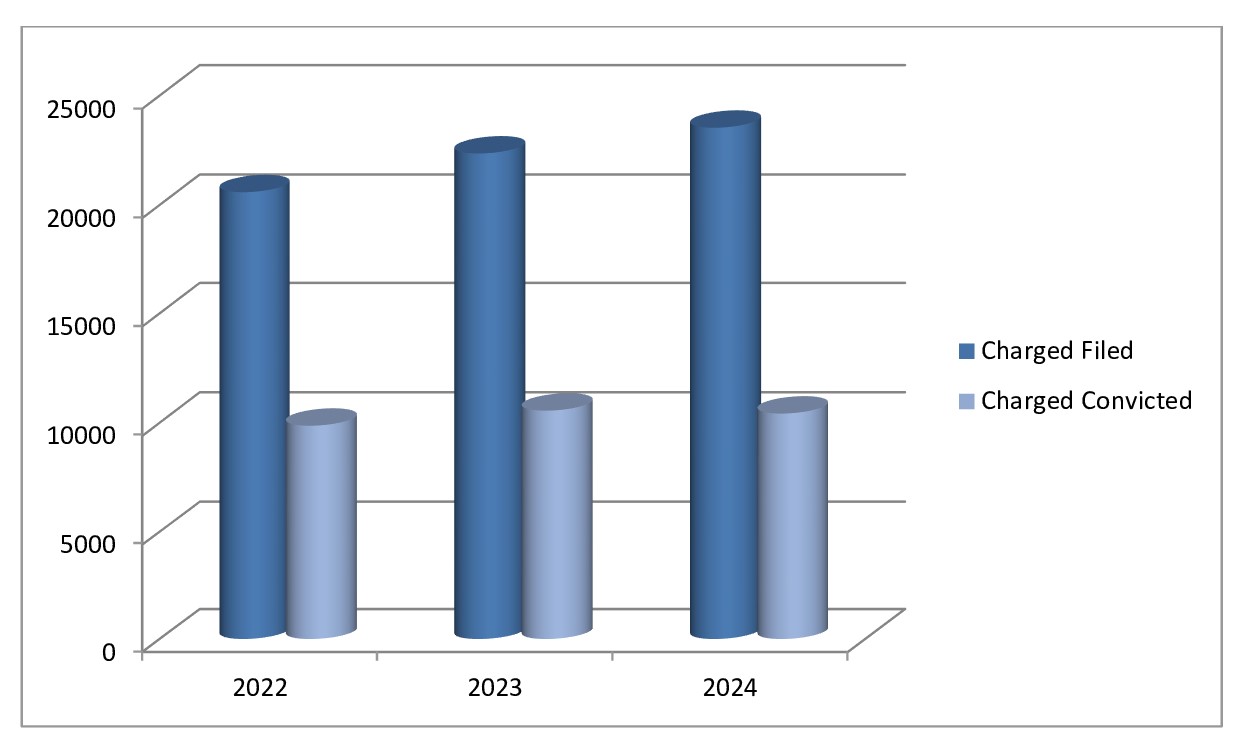
Note about the retained historical chart
The chart below was included in an earlier version of this article. Its 2022–2024 filing and conviction totals have not been verified against an identifiable official dataset and should not be relied on as Minnesota court statistics or evidence of a trend. It does not establish how video or store reports affect case outcomes.