


Reviewed by the Marketing Team Last updated
A Minnesota divorce appeal asks a higher court to review an appealable decision for error using the existing court record. It is generally not a new trial or an opportunity to introduce updated income records. Property division and spousal maintenance can involve different standards of review, and the deadline depends on whether you are appealing a judgment or an order.
How long do you have to appeal a Minnesota divorce decision?
Under Minnesota Rule of Civil Appellate Procedure 104.01, unless a statute provides a different time, an appeal from a judgment generally must be taken within 60 days after entry. An appeal from an appealable order generally must be taken within 60 days after any party serves written notice of its filing.
Those are different triggering events. Do not calculate the deadline solely from the hearing date, the judge’s signature, or the date you happened to read the decision. Review the court register, entered judgment, filed order, service documents, and any applicable special rule together.
Certain proper and timely postdecision motions listed in Rule 104.01 affect the appeal period. When the rule applies, the period runs from service by a party of notice of filing of the order disposing of the last outstanding qualifying motion. An informal request to reconsider, an unauthorized motion, or an untimely motion should not be assumed to extend your deadline.
Get the specific deadline checked promptly. Waiting to decide whether an appeal is worthwhile can use up the time needed to preserve it.
Can every financial ruling be appealed immediately?
No. First identify an appealable judgment or order. Rule 103.03 identifies categories of appealable decisions. A final judgment and a ruling made while litigation is still underway do not necessarily have the same route to review.
A document’s importance to your finances does not by itself make it immediately appealable. Ask whether review is available now, after entry of judgment, or through another authorized procedure. Also identify exactly which portions of the decision you intend to challenge.
Which standard of review applies?
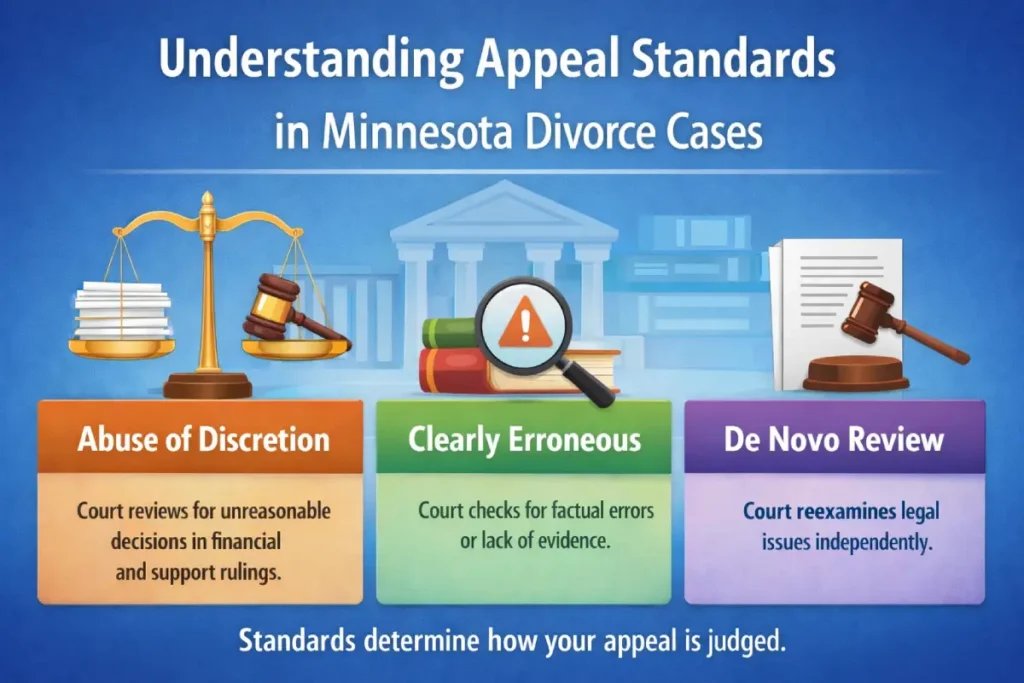
The standard depends on the issue, not simply on whether the case involves divorce. One appeal may involve all three of the following standards.
- Legal questions: de novo review means the appellate court independently decides the legal issue.
- Factual findings: clearly erroneous review gives deference to the district court’s findings and its opportunity to assess witness credibility. It is not a fresh choice between competing versions of events.
- Discretionary decisions: abuse-of-discretion review asks whether the district court exercised its discretion within the governing law and supported record. Applying the wrong legal rule or relying on unsupported findings can matter.
Disagreeing with the result does not establish reversible error. An effective argument connects a specific ruling, the applicable review standard, the relevant law, and the record showing why correction is warranted.
How are marital-property decisions reviewed?
Property classification, factual findings, and the ultimate division should be analyzed separately. In Antone v. Antone, the Minnesota Supreme Court explained that whether property is marital or nonmarital is a legal question reviewed independently, while underlying factual findings receive deference. The district court has broad discretion in dividing marital property.
For example, a hypothetical dispute about whether a traced premarital contribution qualifies as nonmarital differs from a dispute over which witness’s valuation the court believed. The first may turn on classification law; the second may depend heavily on supported factual findings.
A proposed appeal should identify the asset, the challenged finding or legal conclusion, the relevant exhibit or testimony, and how the error affected the division. Merely proposing a different split does not explain why the existing one must be reversed.
See our guide to marital and nonmarital property in Minnesota for the underlying classification issues.
How are spousal-maintenance decisions reviewed?
Maintenance decisions generally receive abuse-of-discretion review. In Dobrin v. Dobrin, the Minnesota Supreme Court emphasized the district court’s discretion and the need for findings supported by the record. Appellate review does not allow the reviewing court simply to reweigh the evidence.
The analysis may include whether the court applied the governing maintenance law, addressed required factors, supported its income and expense findings, and explained its amount and duration decision. Review the version of the law applicable to the decision rather than assuming an older case’s substantive maintenance rules remain unchanged.
Section 518.552 contains Minnesota’s maintenance framework. Current statutory duration provisions do not eliminate the need to analyze eligibility, financial circumstances, and applicable presumptions and exceptions.
A useful review separates legal errors from factual disputes. For example, failing to apply a required statutory factor raises a different question from choosing between two supported estimates of reasonable expenses.
What is the difference between an appeal and a modification?
An appeal examines the challenged decision against the law and record relevant to that decision. A modification request asks the district court to change an existing obligation under the applicable modification rules, often because circumstances have changed.
If income fell after the judgment, that later event does not ordinarily become new evidence in the pending appeal. It may instead require analysis of a maintenance-modification request, the existing decree, and any valid restriction on modification.
Property division is different again. Final property awards generally are not freely adjustable because one party’s financial situation later changes. A request to reopen a judgment under section 518.145 has particular grounds and deadlines and is not a substitute for a missed appeal.
When both appellate and district-court relief are being considered, coordinate them carefully. A pending appeal can affect the district court’s authority over matters involved in that appeal.
What evidence does the appellate court review?
Rule 110 describes the appellate record, including filed documents, exhibits, and the transcript of proceedings. New bank statements or explanations created after the decision generally cannot simply be attached to a brief to expand that record.
Identify which hearings require transcripts and address the transcript requirements promptly. An incomplete record can make it difficult to demonstrate the claimed error. If part of the proceedings was not recorded or a transcript is unavailable, the rules contain procedures that require careful compliance.
Preserving an issue also matters. Whether an argument was raised below, whether an objection was made, and whether a posttrial motion was necessary can affect what the appellate court will review. Do not assume every objection can be raised for the first time on appeal.
Does an appeal stop maintenance payments or property enforcement?
Generally, no. Under Rule 108.01, an appeal does not automatically stay enforcement unless a rule, statute, or court-ordered relief provides otherwise.
A stay request is a separate procedural step. Under Rule 108.02, a party seeking a stay must first move in the trial court. The court may address security or other conditions. Do not stop required payments or ignore transfer obligations merely because a notice of appeal has been filed.
What can happen if the appeal succeeds?
The appellate court may affirm the decision, reverse all or part of it, or send issues back to the district court for further proceedings. A remand may require additional findings or application of the correct legal standard; it does not necessarily guarantee the financial result the appealing party requested.
Consider the practical value of the possible relief alongside attorney fees, transcript expenses, filing costs, and the time involved. A focused challenge to a consequential error may differ substantially from a broad disagreement with the entire decree.
What should you bring to an appeal consultation?
- The judgment and every order relevant to the disputed issue.
- The court register and notices of filing or entry, with service information.
- Postdecision motions and the orders resolving them.
- Available transcripts and the dates of relevant hearings.
- Financial exhibits and the findings you believe are incorrect.
- A short explanation of the legal error and the relief you seek.
- Information about current enforcement obligations and any requested stay.
Organize the disputed issue around what the court actually decided. An exhibit-by-exhibit explanation is more useful than an unsupported statement that the whole result was unfair.
Frequently asked questions about Minnesota divorce appeals
Can I appeal just the maintenance portion of my divorce?
A financial issue may be the focus of an appeal from an appealable decision. The notice, scope of review, preservation requirements, and relationship to other portions of the judgment need careful review.
Can I submit a new appraisal on appeal?
Generally, the appeal reviews the existing record. A new appraisal does not automatically become appellate evidence. Discuss whether another properly available procedure addresses the issue.
Does a request for reconsideration give me another 60 days?
Do not assume so. Rule 104.01 identifies qualifying motions and requirements. The motion’s substance, authorization, timing, and resulting order matter.
Will a successful appeal automatically reduce what I owe?
No. The remedy may be further district-court proceedings. Continue complying with existing obligations unless valid relief changes or stays them.
Review the decision and deadline promptly
Minnesota Divorce Attorneys PLLC provides family-law services under the Martine Law brand. Request a consultation about a financial or maintenance ruling, appellate deadlines, or the distinction between appeal and modification.
Phones and chat are answered 24/7, with AI covering when no staff is free.
This page provides general information about Minnesota law, not legal advice for your particular situation.
