


Reviewed by the Marketing Team Last updated
If you’ve been charged with a crime in Minnesota, you may hear about the criminal history point system.
This system is a critical part of how judges decide sentences, especially for felonies. Understanding how it works can help you know what to expect and why your past record matters so much.
What is the Minnesota criminal history point system?
Minnesota uses a Sentencing Guidelines Grid, developed by the Minnesota Sentencing Guidelines Commission, to determine felony sentences.
The grid combines:
- Severity of the current offense (rankings differ across the Standard, Drug Offender, and Sex Offender grids), and
- Your criminal history score (points assigned based on your past record).
The higher your score, the harsher the presumptive sentence.
See the Minnesota Sentencing Guidelines Grid (mn.gov)
How criminal history points are calculated
The Minnesota Sentencing Guidelines assign points in several categories:
- Prior felony convictions
- Count eligible prior felony sentences under the governing rules; not every record entry adds a point.
- More serious prior felonies add more points.
- Non-Minnesota records require equivalency and sentence review. The state must establish the necessary facts; the court decides whether and how they count.
- Custody status at the time of the offense
- Use the Guidelines version applicable to the offense. Current rules provide a separate custody-status duration adjustment in qualifying cases; do not automatically add one history point for every supervision status.
- Misdemeanor and gross misdemeanor convictions
- Only qualifying misdemeanor and gross-misdemeanor records generate units; an offense label alone does not establish eligibility.
- Four eligible units produce 1 point (maximum 1 point from this category).
- Juvenile adjudications
- Juvenile treatment depends on the governing version and disposition. Current rules count qualifying extended-jurisdiction juvenile convictions within the felony component; do not apply an old general juvenile-point rule without checking.
- Review the actual disposition and applicable rules with counsel.
- Special sex-offense rules
- Sex-offense weighting and custody adjustments require case-specific review; do not count the same label as a free-standing extra point.
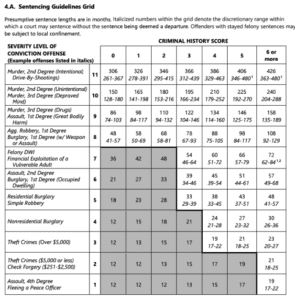
This retained image is a historical illustration, not confirmation of the current grid or your sentence. Consult the official grids and the version applicable to the offense date.
Why your score matters
Your criminal history score is placed on the sentencing grid along with the severity level of your current offense.
- Illustration: Identify the applicable grid and severity level 5 felony and history column before evaluating disposition. A charge alone is not a sentence.
- Read the disposition, range, mandatory rules, and applicable custody adjustment together; a score alone is not a prediction.
In other words, the worksheet needs accurate records and legal review.
Can judges depart from the guidelines?
Yes, judges can order a sentence that is different from the guidelines in certain situations:
- Downward departure: A supported reduction in duration or change in disposition; these are separate decisions.
- Upward departure: An increase requiring a valid legal basis and applicable fact-finding procedures.
Departure generally requires identifiable, substantial, and compelling circumstances; judicial discretion remains constrained by law.
How this affects your case
- Even one prior felony can significantly increase your score.
- Check eligible records, dates, exclusions, and any double-counting limits before accepting a worksheet total.
- Decay rules can exclude qualifying older records; they do not merely reduce the weight of every old conviction. Check dates and exceptions.
Key takeaways
- Minnesota uses a criminal history point system to calculate presumptive felony sentences.
- Points come from eligible prior records under the applicable Guidelines version; custody-status and special rules require separate review.
- The more points you have, the harsher your expected sentence.
- Judges can sometimes depart from the guidelines, but that’s not guaranteed.
- An experienced Minnesota criminal defense lawyer can challenge how points are calculated, protect your rights, and argue for leniency.
At Martine Law, we help clients navigate the complex sentencing system in Minnesota. We understand how criminal history points are calculated and how to fight for the best possible outcome.
If you’re facing criminal charges in Minnesota, contact Martine Law today for a confidential consultation: Martine Law Contact
Who assists with intake?
A Director of Client Engagement (non-attorney) may help with intake and scheduling. This role does not provide legal advice. An attorney reviews the charge, offense date, prior sentencing records, and worksheet. Bring existing documents you lawfully hold and flag disputed entries.
See Guidelines section 2 for the governing calculations and exceptions.