
In Minnesota sex crime trials, rape-shield rules limit when evidence about an alleged victim’s prior sexual conduct can be introduced. That matters because the court usually focuses the trial on the charged event, while allowing only narrow exceptions that must be raised and decided through a pretrial process. The rape shield law Minnesota uses also affects what the jury may hear and what the judge must review first.
Rape-shield rules in Minnesota generally restrict evidence about an alleged victim’s prior sexual conduct in sex offense cases. In practice, the rule keeps the trial focused on legally relevant issues rather than broader sexual history, and the rape shield law Minnesota uses works through Rule 412 and related statutes.
Whether this evidence can be raised often depends on the reason it is offered and whether it fits a narrow exception recognized by law. Courts also use a required motion-and-hearing process before this kind of evidence may be presented in front of a jury.
Martine Law provides general guidance on how Minnesota sex crime procedures and evidence questions are handled under state law.
What Do Minnesota Rape-Shield Rules Usually Limit
Minnesota rape-shield rules generally limit evidence or references about an alleged victim’s previous sexual conduct in certain sex offense prosecutions. The basic purpose is to prevent the subject from being presented to the jury unless the court first authorizes it under a narrow legal process.
Under Minnesota law, the restriction is not only about formal exhibits. It also covers references made in the jury’s presence unless the judge has entered an order allowing the evidence, including in some sexual assault prosecutions.
Which Types Of Evidence Does the Rule Blocks
The rule generally blocks evidence offered only to show prior sexual conduct or to invite broad assumptions from that history. It is designed to keep the trial from shifting into generalized character arguments that do not fit the issues the court must decide.
It also works alongside jury-instruction limits. Minnesota statutes say jurors should not be told to infer consent from prior sexual conduct with others, and they should not be told that prior or later sexual conduct by itself determines credibility. Those restrictions help define the role the rule plays at trial.
When Prior Sexual Conduct Evidence May Appear
Prior sexual conduct may appear only in limited circumstances recognized by the rule and statute. In Minnesota, the main categories involve consent-based issues in narrow situations and source-of-evidence issues involving semen, pregnancy, or disease.
The table below shows the basic distinction.
| Category | May Be Considered? | Basic Reason |
| Prior sexual conduct was offered as a general character attack | Usually no | The rule bars that type of use unless the court orders otherwise under the limited process. |
| Prior sexual conduct with the accused, when consent is a defense | Possibly | The rule recognizes this as a limited category that may be considered. |
| Prior sexual conduct offered to show a common scheme or plan, when consent is a defense, and required findings are made | Possibly | The judge must make specific findings before allowing it. |
| Specific sexual conduct is offered to show the source of semen, pregnancy, or disease | Possibly | The rule allows this for source-identification purposes in narrow circumstances. |
These categories do not mean the evidence comes in automatically. Even within an allowed category, the judge still decides admissibility under the required legal standards before trial or outside the jury’s presence, and related forensic exams may still shape what evidence is reviewed.
Know more: How Prior Acts Are Used in Criminal Sexual Conduct Trials in Minnesota
How Judges Review Admissibility Issues Before Trial
Judges decide these questions through a structured pretrial process. Under Minnesota statute, the accused must make a motion with a particularized offer of proof, and the court may then hold a hearing outside the jury’s presence before ruling on whether the evidence is admissible.
The court does not look only at whether the topic fits a listed category. The judge also weighs whether the proposed evidence’s probative value is substantially outweighed by its inflammatory or prejudicial nature. That balancing step is a central part of how evidence rules in sex crimes in Minnesota cases are applied in actual trial practice.
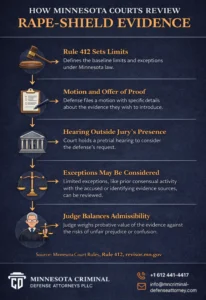
How Minnesota Courts Review Rape-Shield Evidence
This visual outlines the basic path Minnesota courts use when rape-shield evidence becomes an issue in a sex crime case. It shows that the court does not treat prior sexual conduct as open trial material by default. Instead, the issue is reviewed through a structured process that starts with Rule 412, moves through a motion and hearing, and ends with a judicial admissibility decision.
Source: Minnesota Court Rules, Rule 412: Past Conduct of Victim of Certain Sex Offenses
The infographic also reflects why this process matters in practice. Under Rule 412, prior sexual conduct evidence is generally not admitted unless the court authorizes it, and even then, the judge must determine that its probative value is not substantially outweighed by its inflammatory or prejudicial nature. That is why the court reviews the issue before the jury hears it.
What Information The Jury Is Not Told
The jury is not supposed to receive certain types of guidance that would turn prior sexual conduct into a shortcut for deciding consent or credibility. Minnesota law specifically bars instructions that prior sexual conduct with others makes later consent more likely, and it also bars instructions that such conduct alone determines credibility.
This matters because rape-shield rules affect not just what evidence may come in, but also how the trial is framed. The rule helps keep the jury’s focus on admissible proof, the charged conduct, and the instructions the court is legally permitted to give.
How Rule 412 Fits Into the Trial Process
Rule 412 fits into the trial process as an early screening device for sensitive evidence questions. Instead of waiting for the issue to surface in front of the jury, Minnesota procedure usually requires the court to review the issue first and define the limits of any permitted evidence.
In practical terms, that process usually involves:
- A defense motion made before trial, unless good cause supports a later request.
- A detailed offer of proof describing the proposed evidence.
- A hearing outside the jury’s presence.
- A judicial ruling that states the extent of any admissible evidence.
- A possible renewed request if new information is discovered later in the trial.
Why The Rule Remains Narrowly Framed Here
The rule remains narrowly framed because Minnesota law treats prior sexual conduct evidence as admissible only in limited situations, not as a general trial topic. Committee comments to Rule 412 also explain that the rule was shaped to avoid turning sexual history into a broad tool for attacking the alleged victim when the evidence does not relate to the issues being tried.
That distinction also matters in sexual exploitation cases, where courts still separate admissible proof from broader character-based inferences. The court must decide whether the evidence fits a recognized exception, whether the required showing has been made, and whether the balancing standard supports admission.
What Rape-Shield Rules Mean In Minnesota Practice
In Minnesota practice, rape-shield rules shape sex crime trials by limiting when prior sexual conduct can become part of the evidence. They matter because they define both the subject matter the jury may hear and the process the court must use before allowing any exception.
The rape shield law in Minnesota does not treat sexual history as an open subject at trial. Instead, it uses narrow categories, a required motion-and-hearing process, and a balancing test focused on admissibility. These rules also help explain why courts address many of these issues before trial rather than in front of the jury.
If you want general information about how sex crime evidence issues may arise in court, Martine Law can provide guidance on the legal process. You can call (612) 979-1305 or visit the Contact Us page for more information.
Frequently Asked Questions
Can Rape-Shield Issues Be Decided Before Trial?
Yes. In Minnesota, rape-shield issues are usually resolved before trial, so the court can set limits on what may be mentioned in front of the jury. That process typically requires a motion, an offer of proof, and judicial review outside the jury’s presence. For a broader case context, the process may help explain where that review fits.
Does The Rule Apply Only To Other Partners?
No. The rule is not limited to conduct involving other people. Minnesota law also addresses prior sexual conduct with the accused, but only as part of a narrow consent-related category. Even then, the evidence is not automatic. The court still reviews the purpose, the required showing, and the admissibility standard before trial.
Can Medical Evidence Change A Rape-Shield Analysis?
Yes. If the prosecution includes evidence of semen, pregnancy, or disease, Minnesota law allows a limited inquiry into specific prior sexual conduct solely to address the source of that evidence. That does not open the door to broad sexual-history evidence. It only creates a narrow source-based issue for the court to review.
Does The Rule Decide Whether Testimony Is True?
No. The rule does not decide whether a witness is truthful. Instead, it regulates what sexual conduct evidence may be admitted and what instructions the jury may receive about that subject. In that sense, the rape shield law Minnesota uses is an evidentiary boundary rule, not a finding about whether an allegation is accurate.